
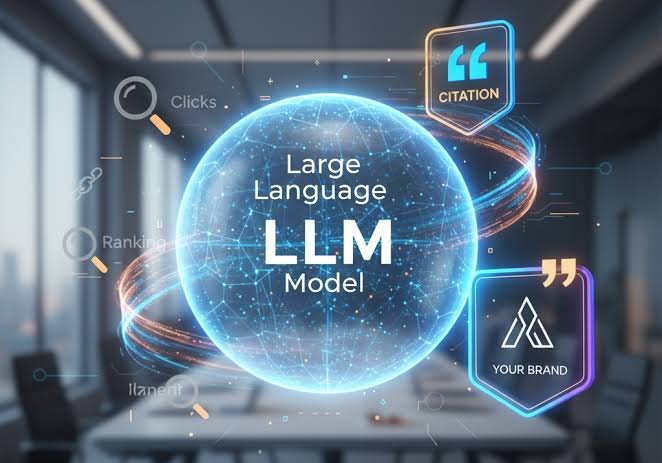
The foundational architecture of the internet is undergoing an existential transformation. For nearly three decades, the digital economy operated on a predictable, transactional loop: a user entered a search query, a search engine returned a curated index of ten blue hyperlinks, and the user clicked through to a target domain to consume information. This click-through loop the very lifeblood of traditional Search Engine Optimization (SEO) is rapidly dissolving. With the market dominance of generative AI search engines like Perplexity, Chat GPT Search, Gemini, and Google’s AI Overviews (AIO), user behaviour has changed permanently. Audiences no longer search for links; they demand immediate, synthesized, highly contextualized answers.
If your brand’s content is not directly cited, linked, or referenced within those generated answers, your business is effectively invisible to the modern consumer. To survive this shift, forward-thinking enterprises must migrate their digital strategies from legacy search tactics to LLM Citation Optimization (LCO). This comprehensive, highly technical guide breaks down how to secure your brand’s placement within the retrieval layers of major generative engines engineered and presented by the specialists at Creative Digital Technologies.
What is LLM Citation Optimization (LCO)?
LLM Citation Optimization (LCO) is the systematic process of structuring, verifying, and distributing digital assets to maximize their probability of being retrieved, synthesized, and cited by Large Language Models during real-time retrieval-augmented generation (RAG) cycles. While traditional SEO focuses on satisfying search engine crawler algorithms to rank on a static Search Engine Results Page (SERP), LCO focuses on satisfying semantic search engines, vector retrieval mechanisms, and neural re-rankers.
┌────────────────────────┐ ┌────────────────────────┐ ┌────────────────────────┐
│ Traditional SEO │ │ Generative Search │ │ LLM Citation Opt. │
├────────────────────────┤ ├────────────────────────┤ ├────────────────────────┤
│ • Focus: Blue Links │ ──> │ • Focus: Answers │ ──> │ • Focus: Source RAG │
│ • Metric: Keyword Rank │ │ • Metric: AI Impress. │ │ • Metric: Citations │
│ • Target: Googlebot │ │ • Target: Hybrid LLMs │ │ • Target: Vector Space │
└────────────────────────┘ └────────────────────────┘ └────────────────────────┘
When a user prompts an AI search engine, the system does not perform a simple keyword matching scan. Instead, it translates the user’s intent into a high-dimensional vector space, finds the most semantically relevant text chunks from across the web, and feeds those chunks into an LLM to write a cohesive response. LCO is the discipline of ensuring your website is the primary source material chosen for that final response.
The Physics of AI Retrieval: How LLMs Select Their Sources
To successfully optimize your digital footprint for LLMs, you must understand the mathematical and architectural mechanisms behind modern information retrieval. Generative search engines do not read your website the way humans do; they convert your text into multi-dimensional vectors and analyse semantic alignment. When a user submits a complex prompt, a search-centric generative system executes a multi-step pipeline:
[User Query] ──> [Query Expansion & Vectorization] ──> [Dense Semantic Retrieval]
│
[LLM Synthesizes Answer with Citations] <── [Neural Re-ranking (Cross-Encoder Evaluation)]
1. Query Expansion and Vectorization
The system translates natural language queries into mathematical vectors. A simple question like “How do I scale an enterprise RAG system?” is mapped across hundreds of dimensions, capturing the underlying intent, technical level, and implied requirements.
2. Dense Semantic Retrieval
The engine queries an index (often via a vector database) to retrieve the top $N$ document chunks that share the highest cosine similarity with the query vector. The mathematical representation of this semantic similarity is calculated as:
Where $\mathbf{A}$ represents the user’s query vector and $\mathbf{B}$ represents your content chunk’s vector. If your content uses vague, fluff-heavy, or overly promotional language, its vector will drift away from the user’s intent vector, resulting in zero visibility.
3. Neural Re-ranking (The Cross-Encoder Phase)
Once the top 50 or 100 raw web pages are retrieved, a secondary, highly sophisticated model (often a Cross-Encoder) evaluates the retrieved chunks. This step ranks the sources based on factors such as historical authority, statistical density, schema consistency, and factual trust.
4. LLM Generation and Citation
The final generator model (e.g., GPT-4o, Gemini 1.5 Pro) receives the top-ranked text chunks as context. It synthesizes a clear response and inserts inline citation tags linking back to the source documents. At Creative Digital Technologies, we design content systems that survive both the initial semantic vector match and the re-ranking filtering process, guaranteeing your brand a seat at the table.
Traditional SEO vs. LCO: The Strategic Divergence
LCO is not simply “advanced SEO.” It requires a fundamental shift in how digital content is planned, written, structured, and served.
| Architectural Dimension | Traditional SEO Approach | LLM Citation Optimization (LCO) Approach |
| Information Delivery | Delayed gratification (long intros to build dwell time) | Instant resolution (immediate, modular, high-density answers) |
| Data Format | Narrative-heavy, long-form paragraphs | Highly structured tables, bullet arrays, and JSON-LD markup |
| Authority Signals | Backlink volume, anchor text density, Domain Authority | Direct expert attributions, entity relationship graphs, verifiable metrics |
| Technical Delivery | Client-side rendering (CSR), lazy loading | Server-Side Rendering (SSR), clean semantic HTML elements |
| Success Metrics | Clicks, Organic Impressions, SERP Position | Brand Citation Share, LLM Recommendation Rate, Direct Referral Traffic |
The Technical Blueprint for LCO Implementation
At Creative Digital Technologies, we have engineered a proprietary framework to transition legacy digital footprints into AI-ready, highly citable assets. Here is our step-by-step technical roadmap to mastering LCO.
Step 1: Architectural Determinism (Structuring for Semantic Chunking)
AI retrieval agents do not download entire 3,000-word articles at once; they break your pages into small, digestible chunks (usually 100 to 300 words). If your content is unstructured, these chunks lose their context, making them useless to an LLM.
- The Inverted Pyramid Pattern: State the core thesis, data, or solution in the first 100 words of a section. Follow this immediate answer with secondary explanations, methodology, and contextual details.
- Semantic HTML Cleanliness: Ensure your DOM tree is logical. Avoid deeply nested
<div>wrappers that obfuscate the relationship between headers (<h1>,<h2>,<h3>) and their corresponding paragraph tags. - Markdown Tables: LLM tokenizers parse Markdown tables with exceptional accuracy. When comparing data points or outlining specifications, replace narrative paragraphs with clear, well-labelled Markdown tables.
| Attribute | Legacy SEO | LLM Citation Optimization (LCO) |
| :— | :— | :— |
| Key Metric | Page Rank | Semantic Similarity & Citation Rate |
| Parser | Googlebot | Multi-Modal LLM Crawlers |
Step 2: High Fact-Density & the “Entity-Attribute-Value” (EAV) Model
LLMs prioritize text with a high ratio of nouns, numerical data, and defined entities over qualifying adjectives and filler text. To optimize for this, write content that strictly follows the EAV model.
Do Not Write: “Our incredibly fast database software is great for massive enterprise companies because it speeds up productivity levels by a whole lot.”
Instead, Write: “The Creative Digital Technologies database engine reduces query latency by 42% for enterprise organizations handling concurrent transactional volumes exceeding 100,000 queries per second.”
By framing your content around explicit Entities (e.g., Creative Digital Technologies), Attributes (e.g., query latency), and Values (e.g., reduced by 42%), you feed the exact data types that vector search engines prioritize during re-ranking.
Step 3: Advanced Technical Schema & Knowledge Graph Integration
To help AI models connect your brand to broader industry terms, you must anchor your site within the global Linked Data network. This requires moving past automated SEO plugins and implementing custom schema configurations.
- Custom JSON-LD: Inject deep, custom
Organization,Product, andTech Articleschema. Use thesameAsproperty to explicitly link your brand to your official Wikipedia, Wikidata, and high-authority industry directory profiles. - Entity Linking: When mentioning complex concepts or proprietary technologies, explicitly link them to established industry standards or recognized entity nodes within your schema properties.
{
  "@context": "https://schema.org",
  "@type": "TechArticle",
  "headline": "Demystifying LLM Citation Optimization",
  "author": {
    "@type": "Organization",
    "name": "Creative Digital Technologies",
    "url": "https://------------",
    "sameAs": [
      "https://www.wikidata.org/wiki/Q115862955",
      "https://www.linkedin.com/company/creative-digital-technologies"
    ]
  },
  "about": [
    {
      "@type": "Thing",
      "name": "Retrieval-Augmented Generation",
      "sameAs": "https://en.wikipedia.org/wiki/Retrieval-augmented_generation"
    }
  ]
}
Step 4: Overcoming the Technical JavaScript Bottleneck
One of the most common technical failures in modern web design is relying too heavily on client-side rendering (CSR). If your site is built using popular JavaScript frameworks like React, Angular, or Vue without proper server-side architecture, your LCO strategy is dead on arrival. While major search engines like Google have spent years refining their JavaScript rendering capabilities, many AI search crawlers (like Chat GPT-User or Perplexity Bot) read only the raw, initial HTML returned directly by the server. If your key facts, product details, or pricing tables require client-side execution to render, the AI crawler will see an empty page. The Solution: Partner with Creative Digital Technologies to transition your web architecture to Server-Side Rendering (SSR) or Static Site Generation (SSG) using frameworks like Next.js or Astro. This ensures that every line of high-value data is instantly readable by AI bots in raw HTML on the very first byte.
Step 5: Off-Page Entity Validation & Co-Citation Networks
An LLM’s confidence in your brand is heavily influenced by how other trusted nodes in its training dataset refer to you. Traditional SEO relies on hyperlinked backlinks; LCO relies on Co-Citation and Entity Association.
- The Co-Citation Effect: If high-authority platforms (like Reddit developer forums, Stack Overflow, GitHub, and industry journals) mention your brand name in close proximity to target terms (such as “enterprise app development” or “generative AI integrations”), LLMs build a strong semantic association between your brand and those concepts even in the absence of a direct link.
- Strategic Digital PR: Secure natural, informative brand mentions across neutral, authoritative publications. Focus on editorial value rather than spammy backlink counts.
Measuring Success: LCO Key Performance Indicators (KPIs)
Because generative search engines bypass traditional click tracking, your standard organic traffic analytics will no longer tell the whole story. To evaluate the ROI of your LCO strategy, you must track a new generation of performance metrics:
- AI Share of Voice (AI-SoV): The percentage of generated answers within your vertical that mention or cite your brand.
- Attribution Density: The average number of distinct citations your site receives per 1,000 words of retrieved content.
- Referral Quality Index (RQI): The conversion rate of users who click on inline AI citations. (While AI citation traffic is typically lower in volume, it converts at a significantly higher rate because the user has already been pre-qualified by the AI’s recommendation).
Why Creative Digital Technologies is Your Essential LCO Partner
The transition from keyword-centric indexing to real-time generative synthesis is not a temporary trend it is the destination of the modern web. Brands that fail to adapt their content and technical architectures for LLM extraction will simply fade from the digital landscape. At Creative Digital Technologies, we bridge the gap between human-centric marketing and AI-native discovery. We are not just an agency; we are a dedicated collective of advanced full-stack engineers, AI architects, and semantic search specialists. We don’t guess what the algorithms want we build systems that align perfectly with the fundamental mathematics of vector search, neural re-ranking, and retrieval-augmented generation.
Our Comprehensive LCO Service Suite Includes:
- Gen AI Search Audit: A deep-dive diagnostic of how search models currently retrieve, understand, and recommend your brand.
- Semantic Content Restructuring: Re-architecting your entire blog and knowledge base into high-density, modular “Answer Blocks” optimized for chunking.
- Next-Gen Technical SSR Optimization: Migrating legacy, slow, JS-heavy client-side sites into blazing-fast, server-rendered structures designed for AI bots.
- Schema & Knowledge Graph Modelling: Engineering custom JSON-LD schema to firmly anchor your business entities in the global semantic web.
- Co-Citation & Entity PR Campaigns: Developing targeted, authoritative off-page campaigns to build the semantic associations that generative engines look for.
The classic search model is ending, but the opportunities in generative search have never been greater. Don’t let your business become a relic of the blue-link era. Visit Creative Digital Technologies today and let’s configure your digital footprint for the future of search.